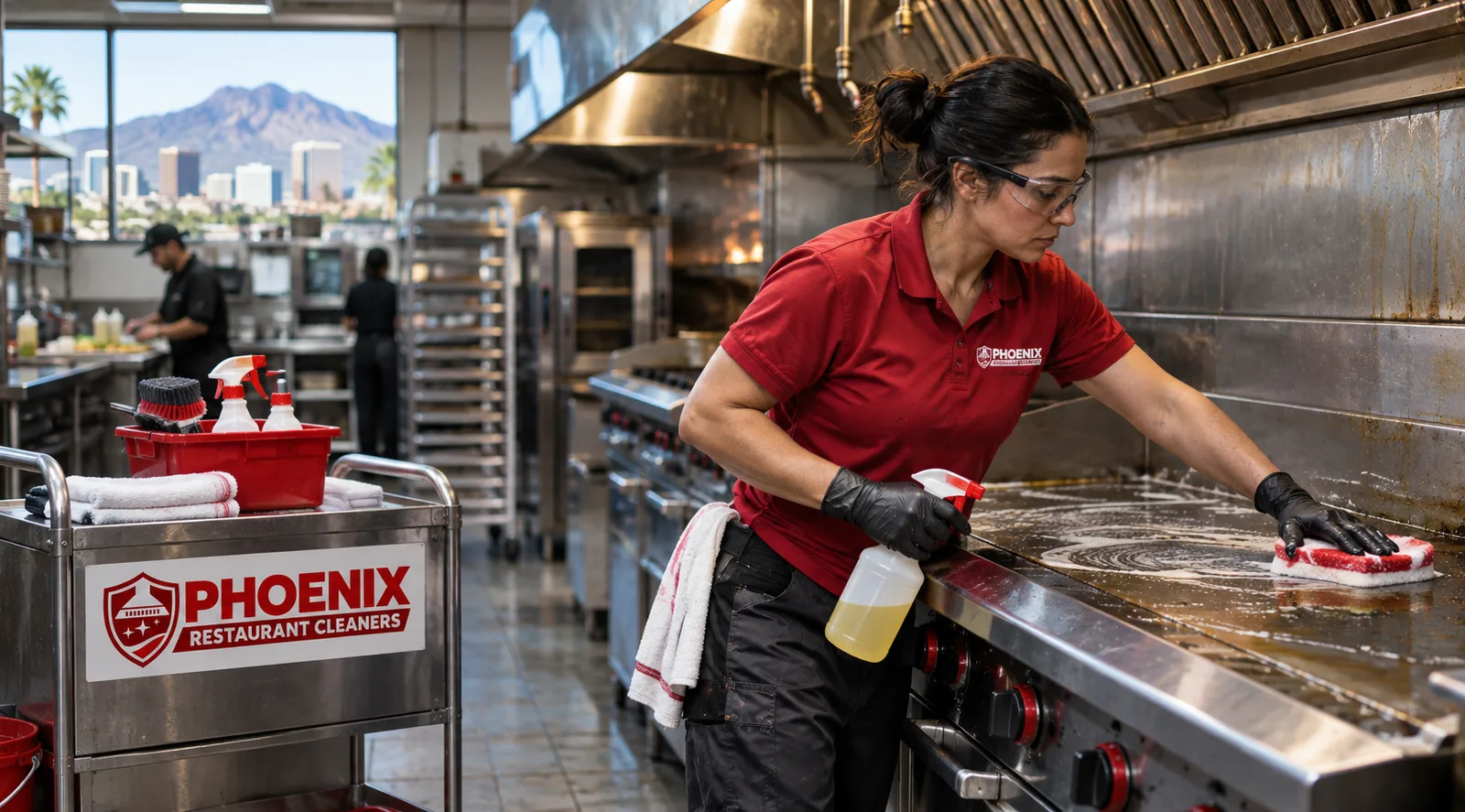
A trained cleaner degreasing stainless steel cooking equipment in an active Phoenix commercial kitchen

Phoenix commercial kitchens

Commercial Kitchen Cleaning Services in Phoenix

Detailed cleaning for cooking equipment, prep areas, floors, walls, and other hard-working surfaces, scheduled around your operating hours.

✓Written scope ✓After-hours scheduling ✓Surface-specific methods ✓Phoenix-based team

Operational outcome

A Cleaner Kitchen Without Disrupting Service

Commercial Kitchen Cleaning Services address the grease, carbon, food residue, and soil that routine closing duties may leave behind. Phoenix Restaurant Cleaners develops a written scope around your equipment, kitchen layout, operating schedule, and priority areas. Work may cover cooklines, prep stations, sinks, walls, floors, accessible equipment surfaces, and difficult spaces beneath or behind movable units.

As Phoenix's restaurant service specialists, we plan the work around the realities of a working kitchen: hot equipment must cool, food and utensils need protection, chemicals require proper dwell time, and cleaned surfaces must be left ready for your staff. Our location near Downtown Phoenix also gives us practical access to commercial districts across the Valley. The goal is a clear, repeatable cleaning plan rather than a generic checklist that misses the conditions unique to your operation.
Scope of work

What Professional Kitchen Cleaning Can Cover

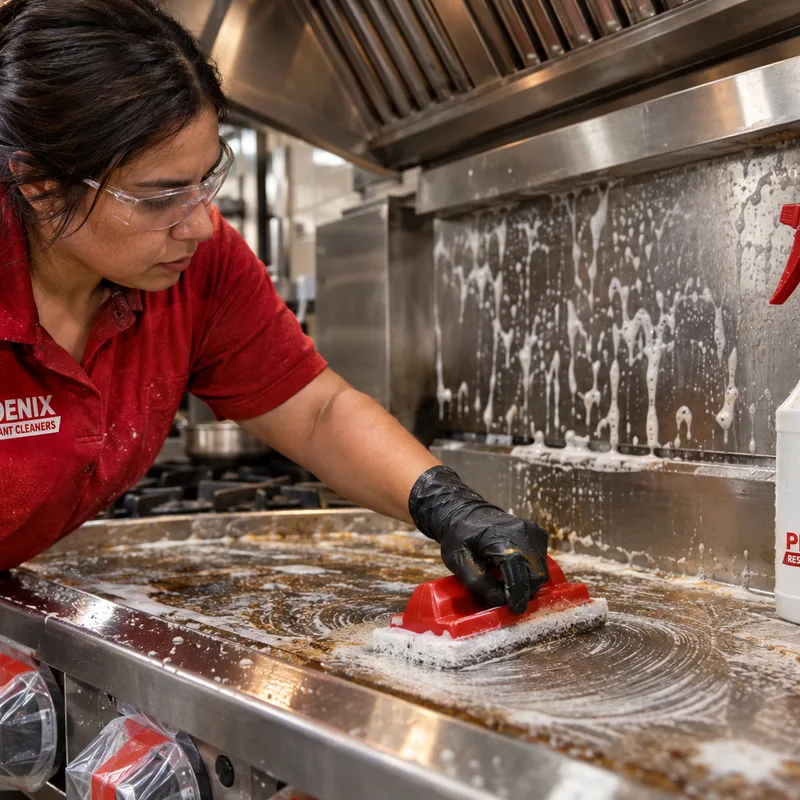
Close view of a commercial cookline being carefully degreased, with stainless steel surfaces, protected controls, and cleaning tools visible

A commercial kitchen deep cleaning starts with the agreed scope. Typical work can include degreasing ranges and fryers, cleaning accessible oven exteriors, detailing stainless steel, scrubbing splash zones, washing walls, cleaning shelving, and removing buildup around equipment legs and casters. Floor care may include sweeping, degreasing, machine scrubbing where suitable, and attention to edges and areas under movable equipment.

Kitchen equipment cleaning must account for manufacturer instructions and sensitive components. Controls, ignition systems, electrical connections, thermostats, and exposed insulation should not be saturated. Crews use controlled application, agitation, scraping tools suited to the surface, and wet extraction or rinsing when the area permits. Aluminum, stainless steel, painted surfaces, and quarry tile do not all tolerate the same chemical or method.

This work complements daily employee cleaning. It does not replace your food-safety procedures, pest-control program, equipment maintenance, or specialized exhaust-system service. Before work begins, the scope should state what will be moved, what stays in place, and which internal equipment components are excluded.

Kitchen zones

Restaurant Kitchen Cleaning by Area

Cookline and Equipment Exteriors

Degreasing for accessible surfaces on ranges, fryers, ovens, griddles, salamanders, worktables, and other equipment included in the written scope.

Prep and Warewashing Areas

Cleaning for prep tables, sink surrounds, shelving, splash zones, and washable surfaces where residue collects during production and cleanup.

Floors, Edges, and Equipment Gaps

Removal of grease and impacted soil from floor fields, wall lines, corners, casters, and reachable spaces beneath movable units.

Walls and Washable Vertical Surfaces

Targeted cleaning for tile, stainless panels, doors, and other compatible surfaces affected by vapor, splatter, or frequent handling.

Walk-In and Storage Areas

Cleaning of accessible floors, shelving, and washable surfaces after food is removed or securely protected according to the agreed preparation plan.

Recurring Kitchen Cleaning Services

Scheduled care based on cooking volume, menu, equipment use, and the rate at which grease and residue return.

Cleaning workflow

How Our Kitchen Cleaning Company Plans the Work

  1. Step 01

    Walk Through the Kitchen

    We identify the equipment, surface materials, access limits, buildup, water availability, floor drains, and operating constraints. This is also the time to flag damaged grout, loose parts, active leaks, or surfaces that need special handling.

  2. Step 02

    Define a Written Scope

    The plan lists included areas, exclusions, equipment-moving responsibilities, preparation requirements, and the expected work window. A defined scope makes quotes easier to compare and helps managers prepare staff.

  3. Step 03

    Prepare and Protect

    Food, utensils, smallwares, and disposable goods must be removed or protected. Equipment is shut down and allowed to cool when required. Sensitive controls and adjacent areas are protected before chemicals or water are applied.

  4. Step 04

    Degrease, Agitate, and Detail

    The crew matches chemistry and tools to each surface, allows appropriate dwell time, loosens buildup, and removes residue using controlled methods. Detail work addresses edges, seams, legs, casters, and accessible gaps.

  5. Step 05

    Review the Completed Scope

    Included areas are checked after cleaning, and any access limitation or equipment condition found during the work is documented. Managers can then confirm that the agreed tasks were completed before the kitchen returns to normal use.

Phoenix scheduling

Commercial Kitchen Cleaning for Phoenix Operations

A professional kitchen cleaning crew unloading labeled supplies at the service entrance of a Phoenix restaurant during an off-hours work window

Phoenix kitchens often operate through long cooling seasons, so air conditioning and ventilation can affect scheduling. Cleaning activity should not interfere with airflow, and equipment must have enough time to cool before degreasing begins. During hot weather, doors should not be propped open longer than necessary because that adds heat and can admit dust or pests.

Dense restaurant areas in Downtown Phoenix may involve loading access, limited service alleys, building rules, or narrow work windows. Roosevelt Row locations can have compact kitchens in adapted commercial spaces, which makes equipment access and staging especially important. In Midtown, mixed-use buildings may require coordination around shared access and neighboring occupants. Tempe operations near Arizona State University may need work planned around event traffic and late operating hours, while Old Town Scottsdale restaurants often need schedules that fit busy dining and entertainment periods.

These conditions influence arrival planning, equipment staging, and the amount of time available for drying and reset. Restaurant kitchen cleaners in Phoenix should ask about parking or loading restrictions, alarm procedures, key access, and the manager authorized to approve the completed work.

Phoenix pricing guide

How Much Does Commercial Kitchen Cleaning Cost in Phoenix?

Commercial kitchen cleaning in Phoenix typically ranges from about $500 to $1,500 for a smaller kitchen, while large, heavily soiled, or equipment-intensive projects may run from $1,500 to $5,000 or more. Recurring maintenance visits may cost less per visit than a first deep clean.

Final pricing depends on kitchen size, grease level, equipment count, access, cleaning frequency, crew hours, and whether equipment must be moved. Interior appliance work and specialized systems may be priced separately. The exact cost is confirmed after a walkthrough or detailed scope review.

Provider standards

Choosing a Restaurant Kitchen Cleaning Provider

Confirm the exact scope

Ask for a scope that names the equipment and surfaces to be cleaned rather than relying on broad terms such as “full kitchen.” Confirm whether walls, floor drains, walk-ins, equipment interiors, and spaces behind units are included. You should also know who disconnects or moves equipment and who is responsible for reconnecting it.

Check methods and safeguards

Professional kitchen cleaning requires more than strong degreaser. The provider should understand chemical dwell time, product labels, dilution, personal protective equipment, electrical hazards, slip control, and the need to protect food-contact items. Safety Data Sheets should be available for the products brought into the facility. Ask how the crew handles delicate metals, painted components, damaged grout, and areas where rinsing is restricted.

Set the work window

Scheduling deserves equal attention. Establish when cooking stops, how long equipment needs to cool, when staff will clear smallwares, and who performs the final opening checks. A dependable proposal sets expectations before the crew arrives and gives management a practical record of what was included.

A walkthrough can turn a broad cleaning request into a practical scope based on your equipment, buildup, access, and operating schedule.

Call for a Free Quote

Operational details

Commercial Kitchen Cleaning Questions

How long does restaurant kitchen cleaning take?+

A focused cleaning may take several hours, while a full deep cleaning can require an overnight work window or longer. Kitchen size, equipment count, grease buildup, access, and the number of crew members affect timing. Downtown Phoenix properties with loading restrictions or tight service corridors may also require additional setup time.

Can professional kitchen cleaning be scheduled after closing?+

Yes, after-hours scheduling is often practical when equipment can be shut down, cooled, and cleared before the crew starts. The work window must also leave enough time for residue removal, drying, inspection, and staff reset. Late-closing operations in Tempe or Old Town Scottsdale should establish precise access and completion times during planning.

Do you clean behind and underneath kitchen equipment?+

Accessible areas behind and beneath movable equipment can be included when movement is safe and approved in the scope. Gas, plumbing, electrical, weight, floor condition, and manufacturer requirements can limit movement. The proposal should identify which party moves each unit and whether a qualified technician is needed for disconnection.

What should staff do before commercial kitchen deep cleaning?+

Staff should remove or securely protect food, utensils, smallwares, paper goods, and personal items from the work area. Equipment included in the job should be emptied, shut down, and cooled as directed. Managers should also provide access instructions, identify sensitive surfaces, and report active leaks or damaged equipment before cleaning starts.

How often should a restaurant schedule kitchen deep cleaning?+

The right frequency depends on cooking volume, menu, equipment type, daily cleaning quality, and how quickly grease returns. Frying and high-volume production usually create different cleaning needs than light preparation. A Phoenix operation with long hours may benefit from dividing the kitchen into recurring zones instead of waiting for one large project.

Does kitchen equipment cleaning include internal components?+

Internal component cleaning is included only when it is specifically listed and safe to perform without technical disassembly. Burners, wiring, ignition systems, refrigeration components, and calibrated controls may require a qualified equipment technician. A cleaning quote should distinguish exterior detailing, accessible interior surfaces, and mechanical service.

Can cleaning be performed while food remains in the kitchen?+

Food must be removed from exposed work areas or protected according to the preparation plan before cleaning begins. Chemicals, airborne soil, water, and equipment movement can create contamination risks. Walk-ins or storage zones that remain stocked need clear boundaries and approved protection before nearby work starts.

Plan your cleaning scope

Plan a Cleaner, More Manageable Kitchen

Tell Phoenix Restaurant Cleaners about your kitchen layout, equipment, current buildup, and preferred work window. We will help define the areas that need attention and prepare a clear scope for review.