
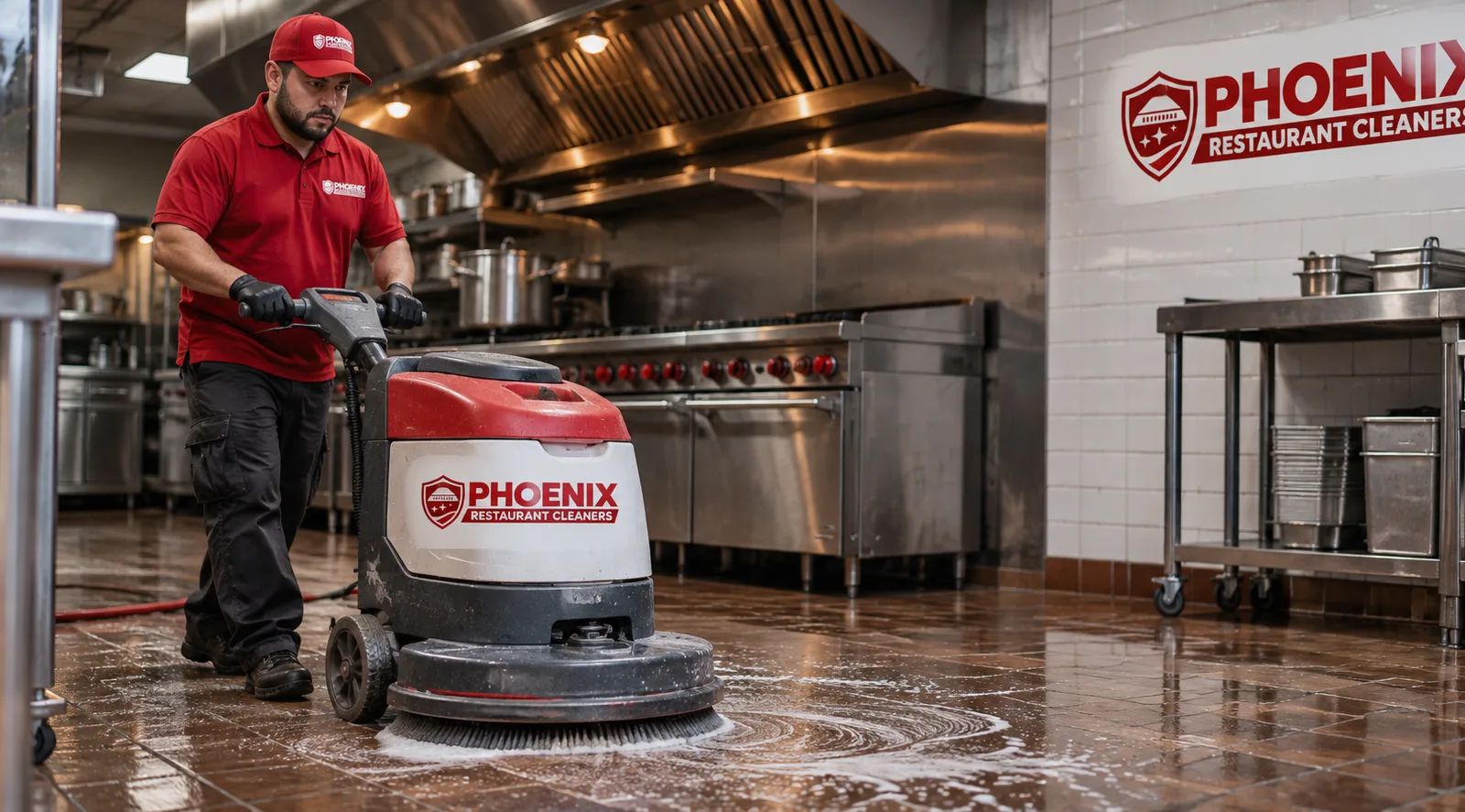
A restaurant cleaning technician using commercial floor equipment on tile in a Phoenix commercial kitchen after food preparation has ended

Phoenix restaurant floors

Commercial Kitchen Floor Cleaning

Remove built-up grease, food residue, and soil from restaurant tile and grout with a cleaning plan fitted to your kitchen, floor material, and operating schedule.

✓Written floor scope ✓After-hours planning ✓Surface-specific methods ✓One-time or recurring service

Operational outcome

A Cleaner Floor Without Disrupting Kitchen Operations

Commercial Kitchen Floor Cleaning targets the grease film, tracked-in soil, food residue, and buildup that ordinary mopping can leave behind. Phoenix Restaurant Cleaners assesses the floor material, grout condition, soil level, equipment layout, drains, and access before recommending a cleaning method. The goal is a thorough cleaning plan that fits the way your kitchen operates.

To accommodate restaurant operating hours, a professional restaurant service company in Phoenix performs this work with close attention to cook lines, prep areas, dishwashing stations, walk-in approaches, and other high-use zones. Cleaning can be planned as a one-time deep service or placed on a recurring schedule based on traffic and grease accumulation.

Our location on East Madison Street provides a practical base for work near Downtown Phoenix, where restaurants may have tight service alleys and limited loading access. Roosevelt Row businesses often need scheduling that accounts for evening activity, while kitchens near the airport and industrial properties around Sky Harbor may operate on extended or irregular shifts. In each case, the work plan should reflect real access and shutdown constraints rather than a generic appointment window.
Floor degreasing

Restaurant Floor Degreasing That Reaches More Than the Open Aisles

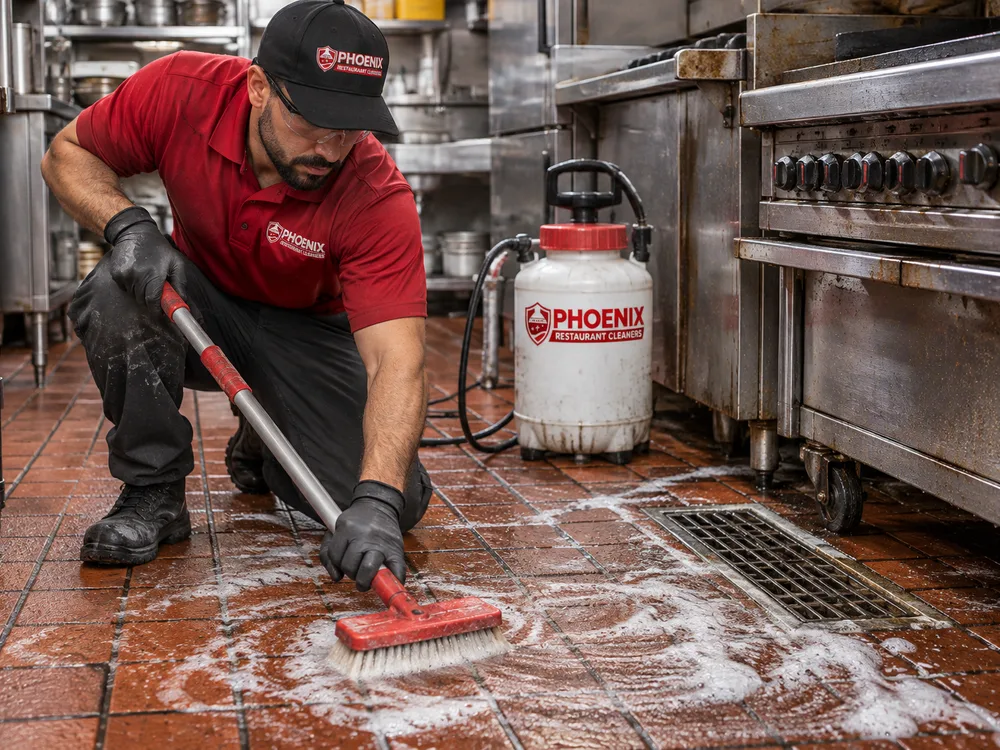
Close view of a technician agitating degreaser across textured quarry tile beside a commercial cook line, with floor drains and equipment edges visible

Kitchen grease settles where routine cleaning is hardest: along equipment edges, beneath movable racks, around floor sinks, beside fryers, and in textured tile. A suitable degreaser needs enough dwell time to loosen oily soil before agitation. If the product is removed too quickly, residue may remain. If it is mixed or used incorrectly, it can leave a film or affect the floor finish.

Restaurant floor degreasing typically begins with dry debris removal and protection of sensitive equipment or adjacent surfaces. The floor is then treated in manageable zones. Mechanical agitation helps release soil from tile texture and grout lines, followed by controlled recovery of the cleaning solution. Edges and corners receive separate attention because a floor machine cannot fully reach them.

Kitchen floor degreasing is adjusted to the surface. Quarry tile, ceramic tile, porcelain tile, sealed concrete, and resilient commercial flooring do not all tolerate the same chemistry or agitation. We confirm the floor type and test an inconspicuous area when the material or prior coating is uncertain. Heavy grease may require repeated passes rather than a single aggressive treatment.

Cleaning coverage

What Restaurant Floor Cleaning Services Can Address

Cook-Line Grease

Degreasing focuses on oily buildup near fryers, ranges, grills, and equipment edges, with chemistry selected for the floor material and soil load.

Tile Texture and Pores

Restaurant tile cleaning uses agitation to release embedded residue from textured surfaces that a mop may pass over without removing.

Darkened Grout Lines

Restaurant grout cleaning works cleaning solution into recessed joints, where grease and soil often collect below the tile face.

Corners and Perimeters

Detail work addresses wall edges, toe kicks, posts, and other narrow areas that require hand tools or smaller equipment.

Prep and Dish Areas

Cleaning plans can include wet-use zones around sinks, prep tables, and dishwasher approaches, subject to safe equipment access.

Dining-Side Hard Floors

When included in the scope, compatible tile and grout in customer areas can be cleaned during the same scheduled shutdown.

Cleaning workflow

Our Commercial Kitchen Floor Cleaning Process

  1. Step 01

    Inspect and Define the Scope

    We identify the flooring, inspect grout and coatings, note heavy grease zones, review drains and water access, and discuss which equipment can be moved safely. The written scope should also identify excluded areas and any damaged grout or tile already present.

  2. Step 02

    Prepare the Work Area

    Loose debris is removed before wet cleaning. Movable items are relocated as agreed, and sensitive surfaces are protected. Work zones are arranged so cleaning solution stays controlled and staff do not enter an active area.

  3. Step 03

    Apply Degreaser and Allow Dwell Time

    A compatible cleaning solution is applied in sections and given time to break down oily soil. Product selection and dilution depend on the surface, buildup, and whether a coating or sealer is present.

  4. Step 04

    Agitate Tile, Grout, and Edges

    Mechanical equipment works the main floor while detail tools address grout lines, corners, perimeters, and equipment transitions. Additional passes may be needed around fryers and other grease-producing stations.

  5. Step 05

    Recover Soil and Review the Floor

    The loosened solution is extracted or otherwise recovered using methods suited to the work area. The floor is rinsed when required, checked for remaining residue, and left to dry before normal traffic resumes.

Floor and joint condition

Restaurant Tile Cleaning and Grout Care

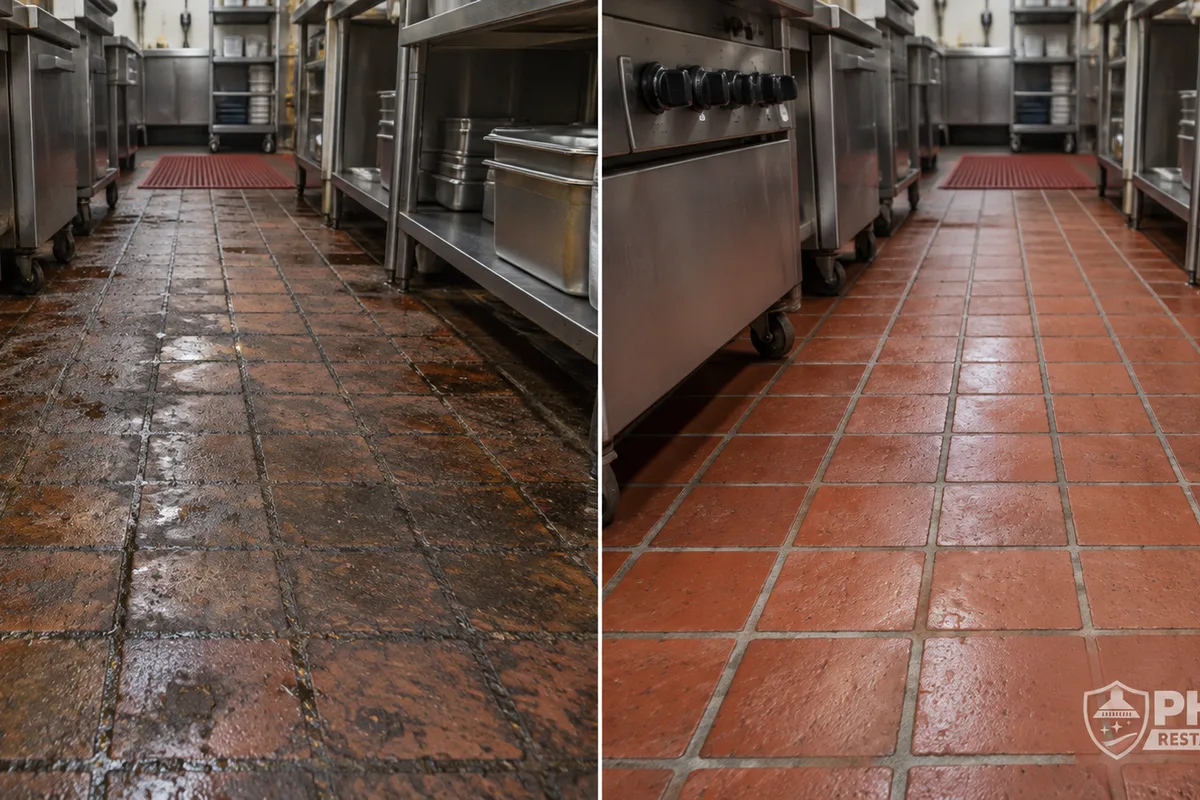
A realistic side-by-side view of the same commercial kitchen quarry tile and grout before cleaning with dark greasy buildup and after cleaning with the original tile texture visible
Tile and grout results depend on the material, prior coatings, wear, and condition of the joints.

Tile and grout should be evaluated separately. Tile may appear clean while recessed grout remains dark because it holds grease, detergent residue, and soil. Restaurant grout cleaning uses targeted agitation and controlled solution recovery to remove that accumulation where the joint is sound and accessible.

Cleaning does not repair cracked tile, missing grout, failed joints, or moisture damage. Those conditions should be documented before work starts because deep cleaning may reveal defects that were hidden by soil. Old sealers and topical coatings can also create uneven results if they are worn through in traffic lanes or peeling near hot equipment.

Phoenix kitchens also contend with fine airborne dust that enters through doors, loading areas, and ventilation-related traffic. When that mineral soil combines with cooking grease, it can form a stubborn film across textured tile. Frequent dry soil removal and correct degreaser dilution help keep the mixture from being spread through repeated mopping. A professional cleaning schedule should respond to the restaurant's cooking volume, traffic, and floor texture rather than follow an arbitrary interval.

Phoenix scheduling

Scheduling Restaurant Floor Cleaning in Phoenix

Restaurant Floor Cleaning Phoenix businesses can use must fit production, deliveries, staff movement, and reopening requirements. Many kitchens need work after closing, before prep begins, or during a planned shutdown. The available drying window matters because foot traffic should not resume while the floor is wet or cleaning is still underway.

Before the appointment, managers should confirm access, identify restricted equipment, remove small floor items, and tell the cleaning crew about damaged tiles, loose grout, coatings, or known drainage concerns. Food, utensils, and portable preparation equipment should be stored or protected according to the restaurant's own procedures. Cleaning methods must also respect equipment manufacturer instructions and the facility's safety plan.

Phoenix's intense summer heat can affect loading access and the movement of equipment and hoses, but it does not eliminate the need for adequate indoor drying and controlled ventilation. Monsoon-season dust and tracked-in debris may also increase the dry soil entering service doors. These conditions support regular sweeping or vacuuming between professional visits so grease is not mixed with loose grit.

Phoenix Restaurant Cleaners can develop a one-time deep-cleaning scope or a recurring plan. Frequency is based on cooking methods, hours, floor texture, grease production, staffing routines, and the standard of appearance the operator needs to maintain.

Get a clear floor-cleaning scope built around your kitchen layout, grease conditions, access limits, and operating schedule.

Call for a Free Quote

Operational details

Questions About Commercial Floor Cleaning in Phoenix

How much does commercial kitchen floor cleaning cost in Phoenix?+

Pricing depends on cleanable square footage, grease severity, floor material, grout condition, equipment access, and whether the work is one-time or recurring. Tight cook lines, heavy buildup, extensive edge work, and short overnight windows can add labor. An inspection or detailed discussion is the best way to establish an accurate written scope.

How long does restaurant floor cleaning take?+

The time depends on floor area, soil level, layout, and the amount of detail work required around equipment. A compact kitchen with open access may be completed in one service window, while a large or heavily soiled operation may need phased work. The plan should include cleaning, solution recovery, inspection, and adequate drying time.

Can kitchen floor degreasing be performed after the restaurant closes?+

Yes, after-hours work can often be scheduled around closing, prep, and reopening requirements. Downtown Phoenix locations may need extra coordination for service-alley access or building restrictions, while extended-hours operations may require cleaning in zones. The exact work window is confirmed before service.

Will restaurant tile cleaning remove dark grout lines?+

It can remove darkening caused by grease, soil, and detergent residue, but it cannot reverse permanent staining or repair damaged grout. Missing joints, cracks, worn coatings, and discoloration within the material may remain visible. Inspection and a small test area can help set realistic expectations.

Is professional degreasing suitable for quarry tile and sealed concrete?+

Both surfaces can often be professionally cleaned, but they require different chemistry, tools, and precautions. Quarry tile is common in commercial kitchens because of its durable, textured surface, while sealed concrete must be assessed for coating condition and chemical compatibility. The surface is identified before the cleaning method is selected.

How often should a Phoenix restaurant schedule deep floor cleaning?+

Frequency should be based on grease production, traffic, floor texture, operating hours, and the effectiveness of daily maintenance. Frying-heavy kitchens may need more frequent restaurant floor degreasing than low-grease operations. A recurring interval can be adjusted after the first cleaning reveals how quickly buildup returns.

Do we need to move kitchen equipment before service?+

Small movable items should usually be cleared, while heavy or connected equipment should move only when it can be done safely and has been included in the scope. The cleaning plan identifies what staff will remove, what the crew can reposition, and which fixed equipment will be cleaned around.

Plan your floor scope

Plan a Cleaner Kitchen Floor

Tell Phoenix Restaurant Cleaners about your floor material, problem areas, kitchen hours, and access constraints. We will help define a practical scope for tile, grout, and degreasing work.