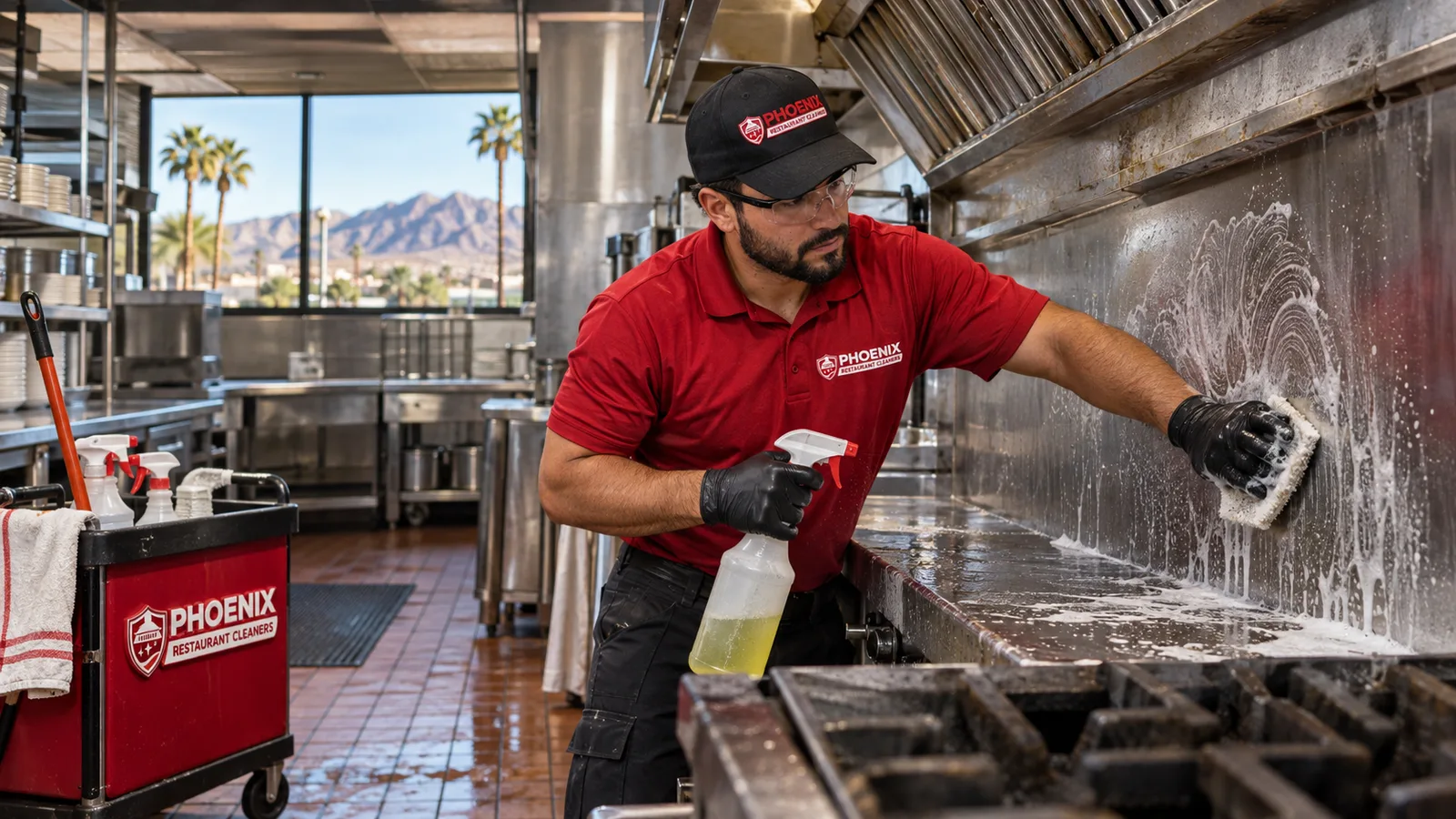
A trained commercial cleaner degreasing stainless steel equipment and surrounding surfaces in a Glendale restaurant kitchen after service

Glendale restaurant kitchens

Restaurant Kitchen Cleaning in Glendale

Detailed degreasing, sanitizing, and overhead cleaning built around your kitchen's equipment, operating schedule, and inspection priorities.

✓Written scope ✓One-time or recurring ✓High-to-low cleaning ✓Glendale scheduling

Operational cleaning

Restaurant Kitchen Cleaning Glendale Operators Can Schedule Around Service

Restaurant Kitchen Cleaning Glendale businesses rely on should address the grease, food residue, dust, and splatter that routine closing work does not always reach. Phoenix Restaurant Cleaners cleans commercial cooking spaces on a one-time or recurring basis, with the scope tailored to the equipment, soil level, access, and available shutdown window.

Our crew can clean cook lines, prep areas, walls, floors, floor edges, washable overhead surfaces, and accessible equipment exteriors. We pay close attention to grease migration around fryers and ranges, residue under movable equipment, and dust on elevated pipes, ledges, vents, and structural elements. For Glendale properties, our restaurant service specialists serving Phoenix, AZ bring a commercial-kitchen approach while coordinating the work around food preparation and service hours.

Glendale includes freestanding restaurants near Arrowhead Towne Center, compact kitchens in Downtown Glendale, and high-traffic dining operations along Westgate's entertainment corridor. Each setting changes the plan. A busy entertainment-area kitchen may need tightly timed overnight work, while an older commercial space may have more exposed overhead surfaces and narrow equipment clearances that require detailed hand cleaning.
Scope of work

What a Detailed Kitchen Cleaning Can Cover

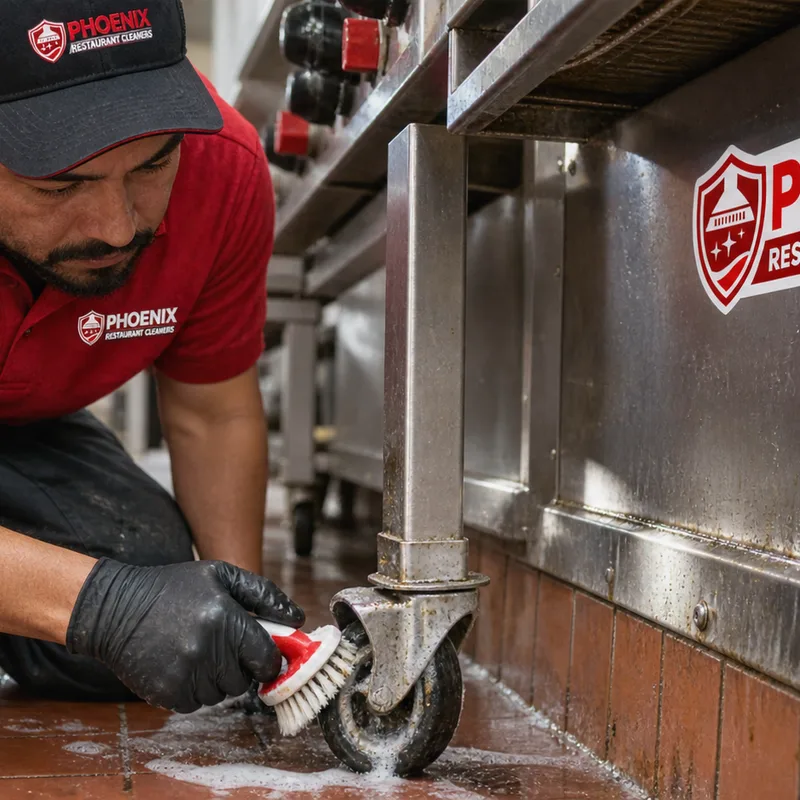
A cleaner detailing grease-prone caster wheels, equipment legs, stainless steel splash guards, and floor edges along a commercial cook line
Detail work targets the edges, supports, and equipment clearances missed during routine closing.

A useful scope separates food-contact surfaces from non-food-contact surfaces and identifies which equipment can be moved safely. Typical work may include degreasing equipment exteriors, cleaning stainless steel backsplashes, washing accessible walls, removing buildup from baseboards and floor edges, scrubbing floors, and cleaning beneath movable appliances. Splash zones, caster wheels, equipment legs, shelving supports, and the gaps beside the cook line often need extra attention.

Degreasing and sanitizing are different steps. Grease, soil, and food residue must first be removed with a compatible cleaner and suitable dwell time. A sanitizer can then be applied where the agreed scope and surface use call for it. Product labels govern concentration, contact time, surface compatibility, and whether rinsing is required. Clean tools should also be separated by task to reduce cross-contact between floors, restrooms, prep areas, and other zones.

Commercial hood ducts, fans, and other parts of a kitchen exhaust system require specialized exhaust cleaning and should not be treated as ordinary surface cleaning. We define accessible hood exteriors and nearby surfaces separately so the written scope is clear.

Cleaning zones

Core Cleaning Priorities

Cook-Line Degreasing

Compatible degreasers and hand tools are used on accessible equipment exteriors, splash guards, walls, and nearby surfaces. Heavy deposits may require repeated applications rather than one aggressive treatment.

Prep and Utility Areas

The plan can address accessible shelving, washable walls, sinks, equipment exteriors, and floor edges while distinguishing food-contact surfaces from other surfaces.

Floors and Equipment Gaps

Scrubbing focuses on traffic lanes, corners, grout lines where present, caster areas, and spaces beneath equipment that can be moved without disconnecting utilities.

Targeted Sanitizing

Sanitizer is applied only after soil has been removed and according to the product label, including its required concentration and contact time.

Restaurant High Dusting

Accessible pipes, ledges, vents, beams, ceiling elements, and fixture tops can be cleaned with controlled methods that limit falling debris.

Inspection-Focused Detailing

Cleaning can be prioritized around visible grease, food debris, dust accumulation, floor-wall junctions, and other sanitation concerns identified during the walkthrough.

Overhead cleaning

Restaurant High Dusting in Glendale

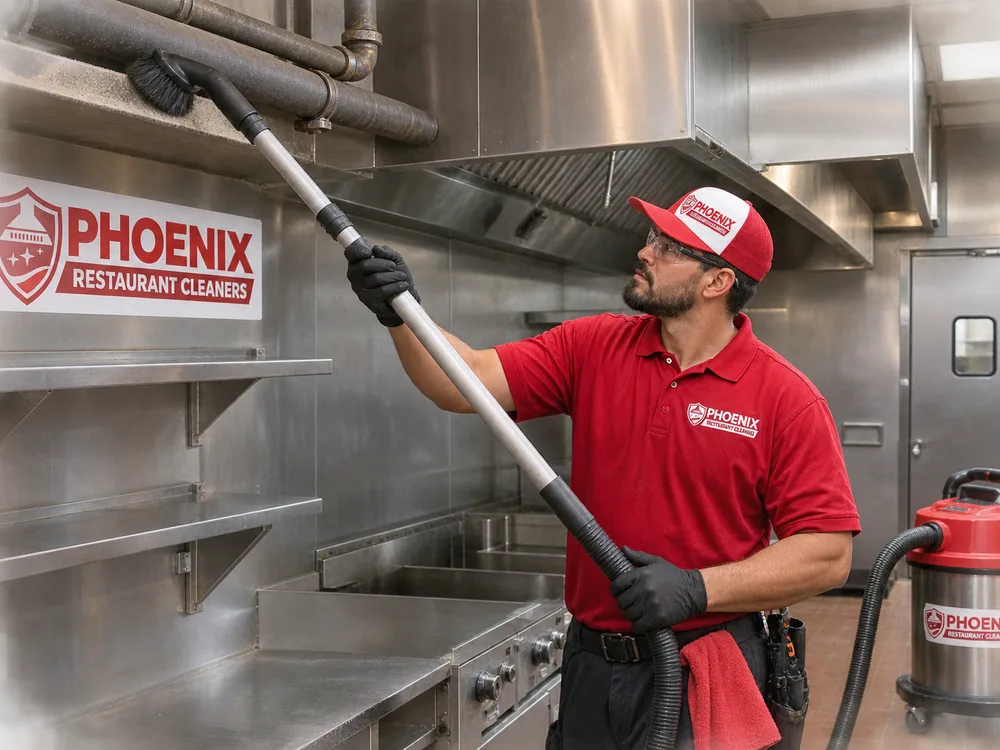
A commercial cleaner using an extension vacuum tool to remove dust from accessible overhead pipes and ledges in an empty restaurant kitchen
High dusting is completed before lower surfaces and floors receive their final cleaning.

Restaurant High Dusting Glendale kitchens need is more involved than wiping a low shelf. Dust and grease can collect on exposed pipes, conduit, ledges, vent faces, light housings, ceiling supports, and the tops of tall fixtures. When airflow or vibration disturbs that buildup, debris may fall toward work areas. A planned top-down cleaning removes overhead soil before lower surfaces and floors receive their final cleaning.

Access determines the method. Extension tools, commercial vacuums with suitable filtration, and properly positioned ladders may be used for reachable surfaces. The crew must also account for hot equipment, fire-suppression components, electrical fixtures, and fragile ceiling materials. Overhead work should occur when food is covered or removed and active preparation has stopped.

Glendale's dry, dusty conditions can add airborne soil whenever receiving doors or exterior doors open frequently. Kitchens near busy visitor destinations such as Westgate may also have narrow turnaround windows between late service and the next prep shift. Those conditions make a defined overhead-cleaning rotation more practical than waiting for visible buildup to become severe.

Cleaning workflow

How the Cleaning Process Works

  1. Step 01

    Walk Through the Kitchen

    We review the cook line, prep and utility areas, overhead surfaces, access restrictions, shutdown time, and any sanitation concerns. The walkthrough identifies what is fixed, what can be moved, and what requires another qualified trade.

  2. Step 02

    Set the Written Scope

    The plan lists included areas, excluded components, cleaning priorities, access needs, and the expected work window. Heavy grease, high dusting, and floor detailing are identified rather than assumed.

  3. Step 03

    Prepare the Work Area

    Food, utensils, smallwares, and exposed ingredients must be removed, covered, or secured as appropriate. Equipment is shut down and cooled when required, and the crew establishes a safe working path.

  4. Step 04

    Clean from High to Low

    Overhead dust is addressed first. Degreasing, surface cleaning, detailed edge work, and floor scrubbing follow so dislodged soil is not deposited onto a finished area.

  5. Step 05

    Review the Completed Scope

    The crew checks the listed work areas, notes inaccessible spots or maintenance concerns, and confirms that cleaned zones are ready for the restaurant's own reopening procedures.

Glendale scheduling

A Cleaning Plan That Fits Glendale Restaurant Operations

Commercial kitchen cleaning works best when the schedule reflects how the restaurant actually operates. Downtown Glendale locations may have older layouts, limited rear access, or closely spaced equipment. Restaurants serving the Arrowhead area may need work planned around steady lunch and dinner traffic. Westgate businesses can face event-driven peaks that leave short windows for deep cleaning. In mixed-use areas near Northern Avenue, delivery access and neighboring businesses may affect when noisy equipment or wet floor work is practical.

Phoenix Restaurant Cleaners can structure service as a one-time deep cleaning, a focused high-dusting visit, or recurring maintenance for selected areas. Frequency depends on cooking volume, menu, ventilation, door activity, staffing, and how much detail the in-house closing crew handles. Frying and high-heat cooking usually create different soil patterns than cold preparation or bakery work.

A professional cleaning does not replace daily restaurant sanitation, pest-control work, equipment maintenance, or required exhaust-system service. It supports those programs by addressing the detailed cleaning tasks that need more time, tools, access, or labor than a normal closing shift allows.

Share your kitchen layout, operating hours, and main problem areas so the cleaning scope can be built around a realistic shutdown window.

Call for a Free Quote

Operational details

Restaurant Kitchen Cleaning Questions

How much does restaurant kitchen cleaning cost in Glendale?+

Pricing is based on the kitchen's size, grease level, equipment density, overhead access, and requested work window. A compact prep kitchen with light soil takes less labor than a high-volume cook line with heavy deposits and exposed ceiling elements. An on-site walkthrough is the best way to establish a written scope and confirm the price.

Can cleaning be completed after the restaurant closes?+

Yes, after-hours cleaning can often be scheduled when the required shutdown window and property access are available. Glendale restaurants with late service or event-driven traffic should allow enough time for equipment to cool, cleaning to be completed, and floors or treated surfaces to dry before the next prep shift.

How long does a restaurant kitchen deep cleaning take?+

The time depends on the scope, buildup, crew access, and whether equipment can be moved safely. A focused cook-line or high-dusting visit may fit within one shutdown period, while a large kitchen with heavy grease can require a longer window or phased work. The expected duration is set after the walkthrough.

Does Restaurant Kitchen Cleaning Glendale include hood and duct cleaning?+

Accessible hood exteriors may be included when they are listed in the scope, but internal exhaust ducts, fans, and specialized system components require qualified exhaust cleaning. Treating those components separately prevents surface cleaning from being confused with fire-safety-related exhaust service.

What must the restaurant do before the crew arrives?+

The restaurant should secure exposed food, remove smallwares from scheduled areas, provide agreed access, and shut down or cool equipment as directed. The walkthrough also identifies utility restrictions, alarm procedures, loading access, and any areas that must remain operational.

Can you clean overhead pipes and exposed ceiling areas?+

Yes, reachable overhead pipes, ledges, vent faces, supports, and fixture tops can be included after access and surface condition are assessed. High dusting is scheduled before lower-level cleaning, with food and preparation tools removed or protected from falling debris.

Will deep cleaning make a restaurant inspection-ready?+

Detailed cleaning can address visible soil and sanitation concerns within the agreed scope, but it cannot guarantee an inspection result. Maricopa County environmental health requirements also involve food handling, temperatures, storage, employee practices, equipment condition, and other operational factors beyond a cleaning crew's control.

Plan your cleaning scope

Plan a Cleaner Kitchen Around Your Operating Schedule

Tell Phoenix Restaurant Cleaners about the kitchen, the buildup you are dealing with, and the time available. We will help define a practical scope for degreasing, detailed cleaning, and high dusting.