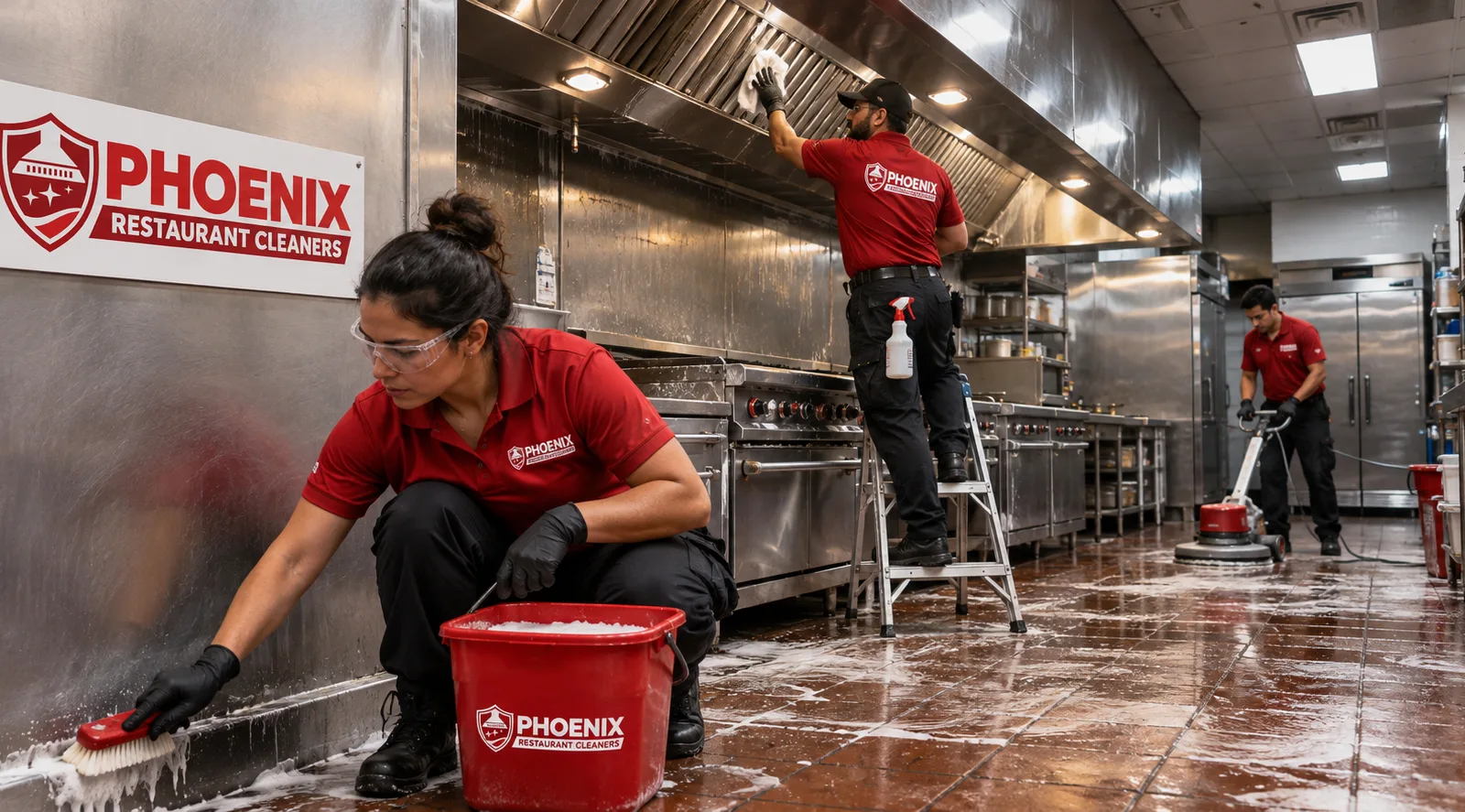
A trained cleaning crew performing a detailed overnight deep clean in a Phoenix restaurant kitchen, with stainless steel equipment, floor edges, and wall surfaces in view

Phoenix restaurant kitchens

Kitchen Deep Cleaning in Phoenix

Detailed commercial cleaning for restaurant kitchens, walk-in coolers, high surfaces, equipment exteriors, floors, walls, and other hard-to-reach areas.

✓Written cleaning scope ✓Operating-hour planning ✓Surface-specific methods ✓Final scope review

Defined cleaning scope

A Cleaner Kitchen Starts With a Defined Scope

Kitchen Deep Cleaning addresses the buildup that routine closing work may leave around equipment, beneath work areas, along wall-floor junctions, and on high surfaces. Phoenix Restaurant Cleaners creates a written scope around the kitchen's layout, current condition, access requirements, and operating schedule. The goal is a practical plan that identifies what will be cleaned, what must be moved, and which areas require special handling.

Local restaurants, caterers, cafés, and food-service teams know a restaurant service company Phoenix homeowners rely on brings the same careful planning to their commercial kitchens. That work may involve degreasing washable surfaces, cleaning equipment exteriors, detailing floor edges, removing loose dust from accessible overhead areas, and cleaning an emptied walk-in cooler. We avoid vague promises. A walkthrough establishes the boundaries of the job before the crew arrives.

Phoenix conditions matter. Airborne desert dust can collect on pipes, ledges, vents, and other elevated surfaces, while sustained kitchen heat can help grease bind to nearby finishes. High dusting and degreasing therefore require separate tools and methods. Downtown kitchens may also have tight loading access and limited storage, so staging and timing must be settled before work begins.
Scope of work

What Restaurant Deep Cleaning Services Can Cover

Cooking-Line Detail Work

Degreasing may cover washable walls, equipment sides and exteriors, splash zones, accessible undersides, and floors around the line. Appliances are moved only when the scope, connections, weight, and site access allow safe movement.

Walk-In Cooler Cleaning

An emptied cooler can be detailed across shelves, walls, doors, gaskets, and floors. Food must be removed or securely relocated, and cleaning products must be suitable for the surface and used according to their labels.

High Dusting

High Dusting in Phoenix kitchens targets accessible pipes, ledges, light housings, wall tops, and overhead structures where desert dust and cooking residue settle. Access height and nearby equipment determine the tools and containment plan.

Floors, Edges, and Drains

Detail work can address corners, grout lines, wall-floor junctions, beneath movable racks, and the exterior surfaces surrounding floor drains. Drain interiors, plumbing repairs, and pest treatment require the appropriate specialist.

Prep and Storage Areas

Shelving, washable walls, rack exteriors, and floors can be cleaned after food, packaging, utensils, and loose inventory are removed or protected. Organizing stock is separate from cleaning it.

Dining-Support Work Areas

Dish areas, server stations, beverage areas, and back-of-house corridors may be added when they are included in the walkthrough. Keeping these spaces in the written scope prevents gaps between kitchen and support zones.

Operational planning

Restaurant Detailed Cleaning Without Disrupting Service

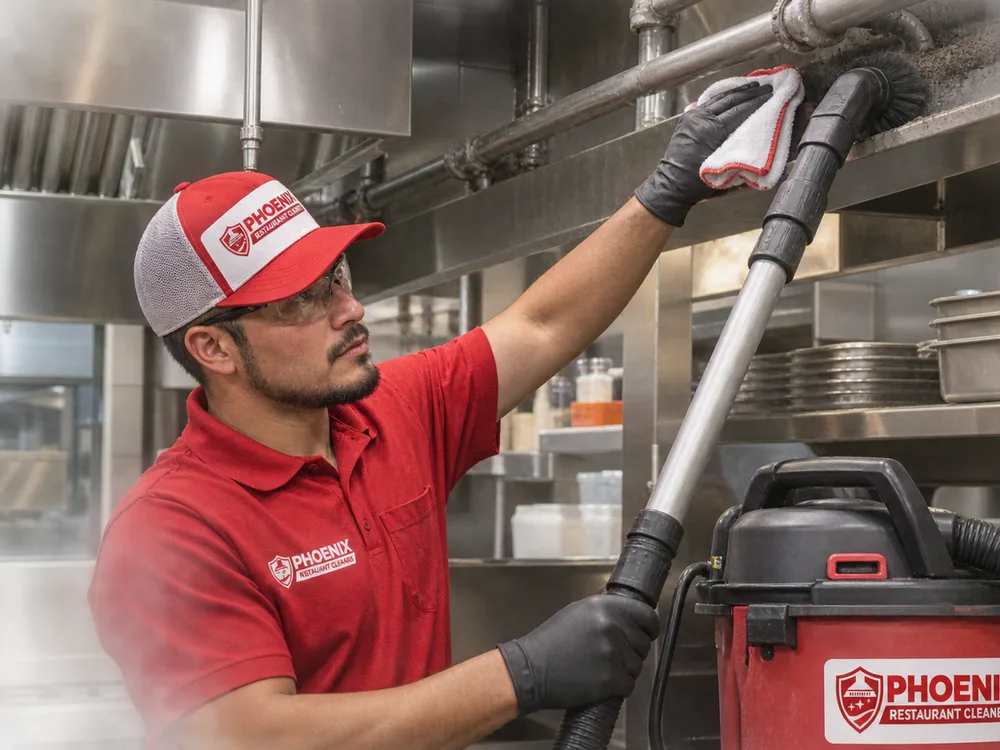
A worker using an extension vacuum and controlled wiping methods to remove dust and residue from accessible overhead pipes and ledges in a commercial kitchen
High surfaces are assessed for safe access before dusting begins.

Professional Restaurant Deep Cleaning is usually scheduled around production, deliveries, and reopening time. A compact kitchen near Roosevelt Row may need phased work because storage and staging space are limited. Restaurant corridors in Downtown Phoenix can involve loading restrictions or shared access. In Arcadia, freestanding restaurant properties may provide different equipment access, while kitchens serving Tempe or Scottsdale traffic may need work timed around late closing hours. These conditions affect crew staging and timing, not the cleaning standard.

Before service, the operator should identify shutoff rules, alarm procedures, restricted equipment, and who is authorized to move food or disconnect appliances. Phoenix Restaurant Cleaners coordinates the cleaning scope with the person responsible for the facility. Cleaning does not replace hood-system service, fire-suppression inspection, pest control, equipment repair, or work inside electrical and mechanical components.

Arizona food establishments operate under applicable food-safety requirements and local regulatory oversight. Deep cleaning can support a facility's sanitation program, but it is not an inspection, certification, or guarantee of regulatory approval. The operator remains responsible for food protection, temperature control, chemical storage, and reopening procedures.

Cleaning workflow

Our Commercial Kitchen Deep Cleaning Process

  1. Step 01

    Walk Through the Kitchen

    We review the cooking line, prep areas, storage, coolers, dish area, floors, and accessible high surfaces. The walkthrough records sensitive finishes, heavy buildup, access limits, and areas outside the requested work.

  2. Step 02

    Build the Written Scope

    The plan lists included surfaces, exclusions, preparation duties, equipment-movement limits, and the intended schedule. This is also when the restaurant identifies food-storage rules and site-specific safety procedures.

  3. Step 03

    Prepare and Protect

    The operator removes or protects exposed food, utensils, packaging, and loose items as agreed. The crew stages tools, confirms chemical compatibility, and separates high dusting from lower-surface cleaning to limit recontamination.

  4. Step 04

    Clean in a Controlled Order

    Work generally proceeds from higher areas toward lower surfaces, followed by detail cleaning around equipment and floors. Dwell time, agitation, rinsing, and drying are adapted to the soil and surface rather than applied as one method everywhere.

  5. Step 05

    Complete a Final Review

    The responsible contact reviews the included areas after cleaning. Any access limitation or condition that prevented completion is documented so the restaurant knows what was addressed before it resumes normal operations.

Cooler preparation

Walk-In Cooler Cleaning Requires Preparation

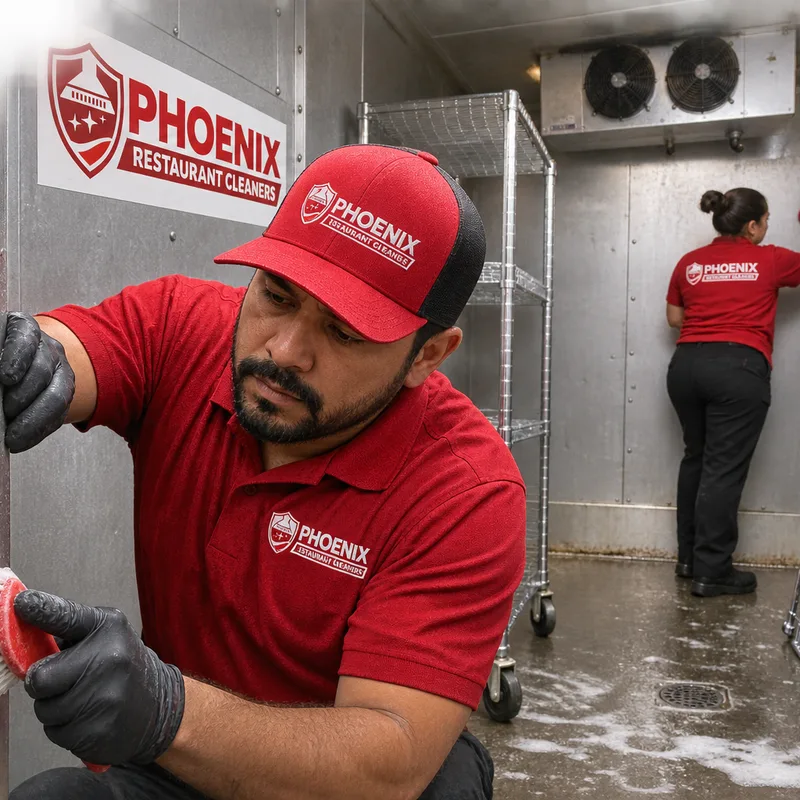
An emptied restaurant walk-in cooler being cleaned, showing detailed attention to removable shelving, door gaskets, wall panels, and floor edges without exposed food
Coolers must be emptied or properly staged before detailed cleaning.

Walk In Cooler Cleaning should be planned before the crew arrives. Food, open ingredients, packaging, and movable containers need an approved temporary location that maintains required temperatures. The operator should decide whether fixed shelving can remain in place and identify damaged gaskets, failing sealant, active leaks, ice buildup, or electrical concerns that require repair rather than cleaning.

The cleaning approach depends on the cooler's construction. Stainless steel, coated metal, quarry tile, polymer shelving, and door gaskets do not all tolerate the same tools or chemicals. Product labels, surface manufacturer guidance, and adequate rinsing inform the method. Saturating fan housings, controls, sensors, lights, and other electrical parts is avoided.

Visible mold-like growth, persistent odors, recurring moisture, or widespread contamination may indicate a building, refrigeration, drainage, or food-handling issue. Cleaning removes accessible soil within the agreed scope; it does not correct the source of condensation or certify microbial conditions.

Provider standards

How Restaurant Deep Cleaners Set the Scope

A useful proposal names surfaces rather than relying on broad terms such as “complete kitchen.” Ask whether the work includes equipment exteriors, areas beneath movable items, walls, ceilings, high ledges, shelving, cooler interiors, floor edges, and drain surrounds. Confirm who moves equipment and inventory, and whether the restaurant must provide access to water, power, disposal areas, or loading space.

Condition also matters. Light dust, carbonized cooking residue, adhesive buildup, mineral deposits, and grease films require different methods. Some staining or finish damage may remain after soil is removed. Bare aluminum, painted surfaces, natural stone, grout, stainless steel, rubber gaskets, and electrical components need material-appropriate treatment. A test spot may be appropriate when a finish or prior coating is uncertain.

Phoenix Restaurant Cleaners bases Restaurant Deep Cleaning in Phoenix on visible conditions and accessible work, not a generic checklist. Share the closing time, required reopening time, equipment restrictions, and known problem areas during the initial conversation. That information helps determine whether the work fits one shift or should be divided into phases.

Get a written cleaning scope that accounts for your kitchen layout, operating hours, cooler preparation, high-access needs, and areas of heavy buildup.

Call for a Free Quote

Operational details

Questions About Professional Restaurant Deep Cleaning

How much does kitchen deep cleaning cost in Phoenix?+

Pricing depends on kitchen size, grease level, equipment density, access, cooler work, high dusting, and the number of crew hours required. A lightly soiled prep kitchen and a high-volume cooking line do not carry the same scope. A walkthrough at the Phoenix property is the reliable way to establish a written price.

How long does Restaurant Deep Cleaning in Phoenix take?+

A defined kitchen area may be completed in one scheduled shift, while a large or heavily soiled facility may require phased work. Closing time, equipment movement, high-access work, and drying time affect the schedule. The expected completion window should be agreed upon before cleaning starts.

Can deep cleaning be completed overnight?+

Overnight work may be available when access, staffing, preparation, and reopening time allow it. The restaurant must provide a responsible contact and complete the agreed food and inventory preparation. Downtown Phoenix loading arrangements or shared-building access should be confirmed in advance.

Does Walk In Cooler Cleaning include moving food?+

Food relocation is normally the operator's responsibility unless the written scope states otherwise. Products must remain protected and at required temperatures while the cooler is cleaned. The restaurant should prepare an approved temporary storage plan before the scheduled service.

What must the restaurant do before the crew arrives?+

The restaurant should remove or protect exposed food, utensils, packaging, and loose inventory as specified in the scope. Staff should also identify restricted equipment, provide authorized access, and communicate alarm, shutoff, disposal, and reopening procedures.

Does High Dusting Phoenix service include hood ducts and fire-suppression equipment?+

High dusting generally covers accessible exterior ledges, pipes, structural surfaces, and similar overhead areas listed in the scope. It does not replace certified kitchen exhaust cleaning, duct service, or fire-suppression inspection. Those systems require qualified providers and their own service schedules.

Can you remove every grease stain and odor?+

Cleaning can remove accessible soil, but permanent discoloration, damaged finishes, absorbed odors, corrosion, failing sealant, and hidden contamination may remain. Recurring odors can signal a drain, refrigeration, pest, or building issue. The final review distinguishes cleaned soil from conditions that need repair or specialist assessment.

How often should a commercial kitchen receive detailed cleaning?+

The right frequency depends on cooking volume, menu, equipment layout, internal closing routines, and the rate of buildup. Heavy grease production or frequent dust accumulation can justify shorter intervals. The operator should combine daily sanitation with periodic detail work based on observed conditions and applicable food-safety requirements.

Plan the cleaning scope

Plan Your Phoenix Kitchen Deep Clean

Tell Phoenix Restaurant Cleaners about the facility, operating schedule, cooler needs, high surfaces, and problem areas. We will help define a practical scope before the work is scheduled.