
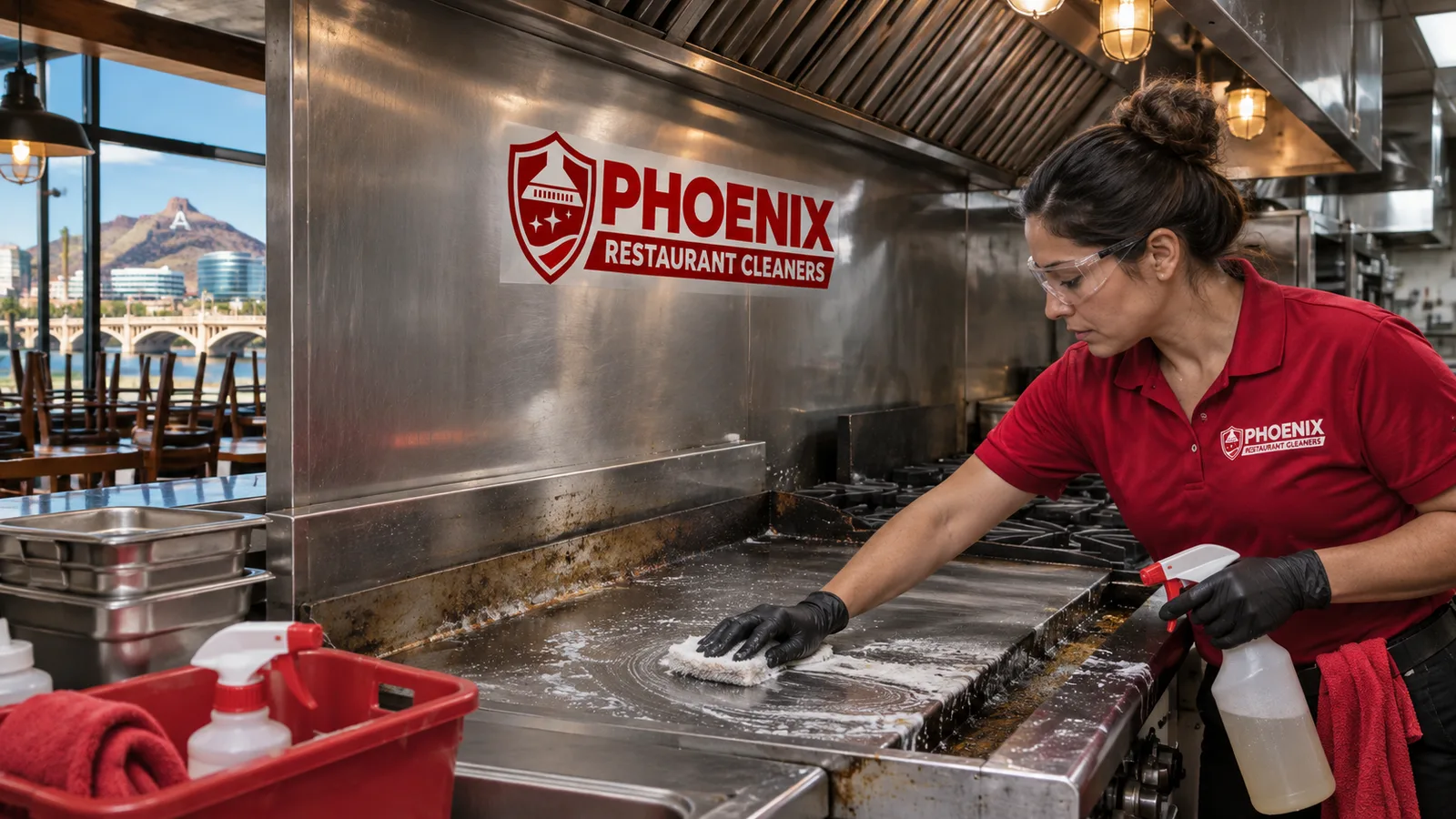
A professional cleaner degreasing stainless steel cooking equipment in an active Tempe restaurant kitchen after service

Tempe commercial kitchens

Commercial Kitchen Cleaning In Tempe

Detailed cleaning for restaurant kitchens, prep areas, equipment exteriors, floors, and other hard-working surfaces, scheduled around service and backed by a clear scope.

✓Written scope ✓Service-hour planning ✓Surface-specific methods ✓Tempe service available

Operational outcome

Dependable Commercial Kitchen Cleaning Tempe Restaurants Can Schedule Around Service

Grease, food residue, carbon deposits, and tracked-in soil build up quickly in a working kitchen. Commercial Kitchen Cleaning Tempe businesses can rely on should address that buildup methodically without disrupting preparation or service. Phoenix Restaurant Cleaners creates a written scope based on the equipment, surfaces, access conditions, and cleaning frequency at each location.

Our crew works as an experienced restaurant service team in Phoenix, AZ, with service available for commercial kitchens in nearby Tempe. We plan around operating hours, explain what must be moved or shut down, and distinguish routine cleaning from intensive degreasing. This approach suits independent restaurants, cafés, bars with food programs, commissary kitchens, and other commercial food operations.

Local conditions affect the work. Tempe's dry climate can carry fine dust into receiving areas and along floor edges, while heavy foot traffic near Downtown Tempe and Mill Avenue can increase tracked-in soil. Kitchens around Arizona State University's Tempe campus may also face sharp changes in volume tied to classes, events, and game days. A cleaning plan should reflect actual use rather than apply the same checklist to every property.
Scope of work

What a Detailed Kitchen Cleaning Can Cover

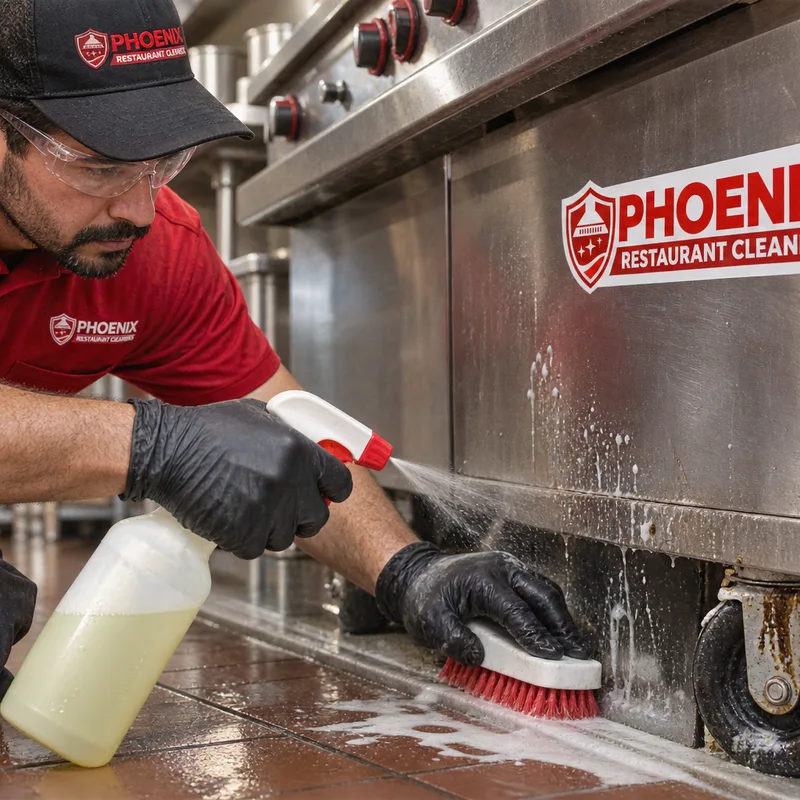
A technician using controlled degreasing methods on stainless steel panels, floor edges, and caster areas beneath commercial cooking equipment
Detail work targets grease traps around edges, joints, casters, and equipment bases.

The scope may include cooking-line exteriors, stainless steel panels, prep tables, sinks, shelving, backsplashes, wall surfaces, baseboards, floor edges, and reachable areas beneath or behind movable equipment. Degreasing is matched to the surface and soil level. Food-contact surfaces receive products and procedures appropriate for those surfaces, followed by the required rinse or finishing step on the product label.

Floors often need more than a quick mop. Grease collects in grout lines, under equipment lips, around casters, and at transitions between the line and prep area. Depending on the flooring, work may include agitation, wet pickup, and repeated rinsing so loosened residue is removed rather than spread. Splash zones and touchpoints can be included when they are identified in the scope.

Cleaning and sanitizing are different steps. Cleaning removes grease, soil, and food residue. Sanitizing follows cleaning on applicable food-contact surfaces using an approved product at its labeled concentration and contact time. Staff should continue following the restaurant's own food-safety procedures and manufacturer instructions after the work is complete.

Kitchen zones

Restaurant Cleaning Tempe Operators Can Tailor to the Kitchen

Cooking-Line Degreasing

Exterior surfaces around ranges, fryers, ovens, and adjacent stainless steel are treated according to buildup and material. Equipment is handled only within the agreed scope and manufacturer-safe limits.

Prep and Warewashing Areas

Prep tables, sinks, backsplashes, shelving exteriors, and reachable wall surfaces can be cleaned after food, utensils, and loose supplies are removed or protected.

Floors, Edges, and Grout

Agitation helps release greasy residue from textured flooring, grout, corners, and baseboards. The method is selected for the floor type, drainage, and access.

Under and Behind Equipment

Reachable voids can be cleaned when equipment is movable and utility connections permit safe access. Heavy or hard-connected units require advance planning.

Recurring Maintenance

Regular visits can focus on high-soil areas before residue becomes harder to remove. Frequency depends on cooking volume, menu, staffing routines, and operating schedule.

Targeted Deep Cleaning

A one-time intensive visit can prepare a kitchen for reopening, management changes, seasonal demand, or a reset after accumulated grease and soil.

Cleaning workflow

How We Plan the Work

  1. Step 01

    Review the Kitchen and Priorities

    We discuss the cooking line, prep areas, flooring, operating hours, current condition, and any access restrictions. Photos or an on-location review may be needed for an accurate scope.

  2. Step 02

    Define Included Surfaces

    The written scope identifies the equipment exteriors, floors, walls, shelving, and other areas to be cleaned. It also notes exclusions, preparation duties, and whether movable equipment must be repositioned.

  3. Step 03

    Coordinate Shutdown and Access

    The restaurant confirms when cooking stops, surfaces are cool, food is stored, and staff or management can provide access. Utility-connected equipment stays in place unless qualified arrangements have been made.

  4. Step 04

    Clean in a Controlled Sequence

    Crews generally work high to low and from lower-soil areas toward heavier buildup. Dwell time, agitation, controlled rinsing, and wet recovery are used as appropriate for the surface.

  5. Step 05

    Walk Through the Completed Scope

    The finished areas are checked against the agreed work. Management can review any stains, wear, damaged finishes, or inaccessible spaces that cleaning cannot correct.

Tempe scheduling

Built Around Tempe's Varied Restaurant Operations

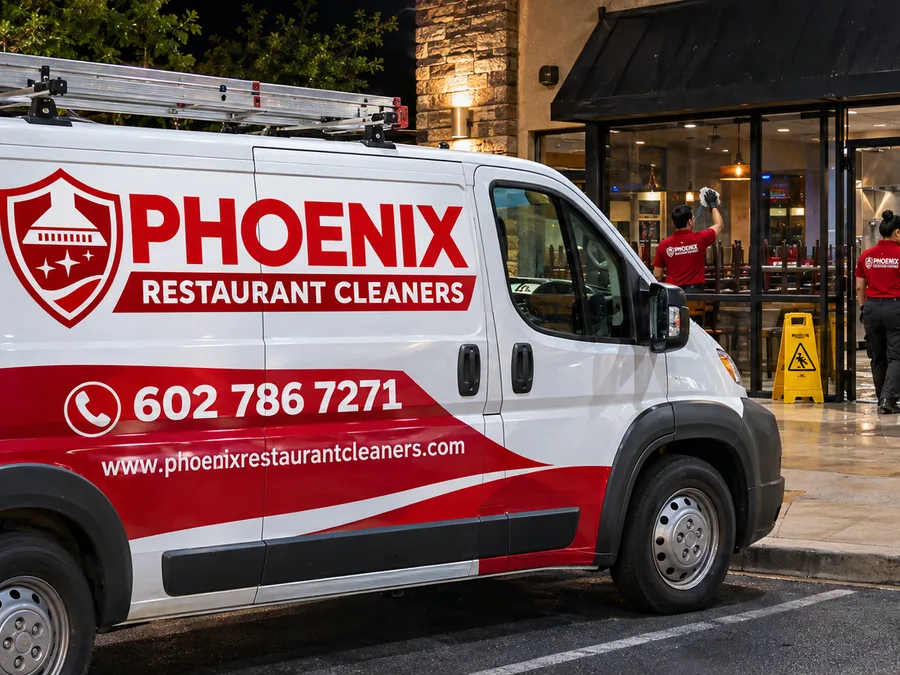
A uniformed commercial cleaning crew unloading kitchen-safe tools and wet-recovery equipment at a Tempe restaurant service entrance during an off-hours work window
Access, parking, loading procedures, and closing times are considered before the crew arrives.

A compact kitchen near Mill Avenue may have tight aisles, late closing times, and limited space for moving equipment. Scheduling must account for pedestrian-heavy service periods and the time required for surfaces to cool. Near the ASU Tempe campus, student traffic and event schedules can cause sudden volume increases, so recurring work may need to shift around peak weeks.

Restaurants around Tempe Marketplace may operate in larger retail footprints with loading-area procedures and property access rules. South Tempe locations often sit in neighborhood shopping centers where early access, shared service corridors, or noise limits can shape the work window. Along Apache Boulevard, kitchens range from small independent operations to newer mixed-use spaces, each with different floor plans and equipment access.

These differences matter during quoting. Square footage alone does not reveal how much grease is present, whether the line can be reached safely, or how long setup and recovery will take. A useful proposal identifies those conditions before cleaning begins.

Tempe pricing guide

How Much Does Commercial Kitchen Cleaning Cost in Tempe?

Commercial kitchen cleaning in Tempe typically costs about $500 to $1,500 for a scheduled deep clean, while compact or limited scopes may run $250 to $500 and large, heavily soiled kitchens may exceed $2,000. These are general, nonbinding ranges. Final pricing changes with kitchen size, grease buildup, equipment density, floor condition, access, required crew hours, and visit frequency. Hood exhaust systems, ducts, and rooftop fans may require separate specialist work. The exact cost is confirmed after the kitchen and requested scope are reviewed.

Pre-service standards

What to Confirm Before Cleaning Day

A successful visit starts with a practical handoff. Food and single-use items should be stored away from the work zone. Cooking equipment needs enough cooling time for safe cleaning, and staff should identify sensitive controls, pilot lights, damaged seals, loose tiles, or surfaces that have reacted badly to chemicals in the past. The person providing access should understand the approved scope and know how to reach a manager if an unexpected condition appears.

Commercial kitchen cleaning does not replace pest control, equipment repair, fire-suppression service, plumbing work, or certified cleaning of grease exhaust ducts and fans. It also cannot restore etched stainless steel, failed grout, corroded metal, or worn flooring. Those conditions should be documented rather than hidden under a temporary shine.

Phoenix Restaurant Cleaners operates from 920 E Madison St, Suite 5, Phoenix, AZ 85034, which provides a practical base for coordinating work in Tempe. Tell us how the kitchen operates, when it is available, and which areas are causing concern. We will use those details to shape a clear scope and realistic work window.

Get a written cleaning scope that accounts for your kitchen's equipment, operating hours, access, and current level of buildup before the work is scheduled.

Call for a Free Quote

Operational details

Commercial Kitchen Cleaning Questions

How often should a Tempe restaurant schedule deep kitchen cleaning?+

The right frequency depends on cooking volume, menu, equipment, and the restaurant's daily cleaning routine. Frying, charbroiling, and high-volume service usually create grease faster than light preparation. Tempe restaurants with event-driven demand near ASU or Mill Avenue may benefit from scheduling intensive cleaning around peak operating periods rather than relying on a fixed calendar alone.

Can cleaning be completed after the restaurant closes?+

Yes, off-hours cleaning is often possible when access, cooling time, and the work window are confirmed in advance. The kitchen must stop cooking early enough for hot equipment to cool safely. Late-night operations near Downtown Tempe may need a phased scope or a different start time to avoid rushed work before morning preparation begins.

Do we need to move kitchen equipment before the crew arrives?+

Light, safely movable equipment may need to be repositioned, but heavy or utility-connected units should not be moved without proper planning. Gas lines, electrical connections, water lines, and casters all affect access. The pre-service review identifies who is responsible for moving each item and which spaces will remain inaccessible.

Does restaurant cleaning include hood ducts and rooftop exhaust fans?+

Hood ducts, exhaust plenums, and rooftop fans should be treated as a separate specialist scope unless they are explicitly included by a qualified provider. General kitchen cleaning may address accessible hood exterior surfaces, but grease exhaust systems involve fire-safety procedures, specialized access, and documentation. The proposal should state the boundary clearly.

How long does a commercial kitchen deep clean take?+

A focused cleaning may take several hours, while a large or heavily soiled kitchen can require a full shift or phased visits. Equipment density, grease condition, floor detail, access, and drying requirements all affect timing. Tempe properties with shared loading or service corridors may also need arrival and removal times coordinated with property management.

Can the crew clean while food preparation is happening?+

Deep cleaning is usually best performed when food preparation has stopped in the active work zone. Chemicals, loosened soil, hoses, and wet floors must be controlled, and exposed food or utensils should be removed or protected. Limited work may be phased into closed areas, but the approved plan should prevent interference with safe food handling.

What information is needed for an accurate Restaurant Cleaning Tempe quote?+

An accurate quote needs the kitchen's approximate size, photos or an on-location review, equipment list, current condition, desired areas, operating hours, access details, and preferred frequency. Mention hard-connected equipment, floor drains, shared service entrances, or tight aisles. Those facts are more useful than square footage by itself.

Can recurring service focus on different areas each visit?+

Yes, recurring service can combine core cleaning with rotating detail areas when that plan matches the restaurant's needs. High-soil floors and cooking-line exteriors may receive attention each visit, while walls, shelving, and less active spaces rotate on an agreed schedule. The scope should still identify what is included each time.

Plan your cleaning scope

Plan a Cleaner, More Manageable Kitchen

Describe your Tempe kitchen, operating schedule, and priority areas. Phoenix Restaurant Cleaners will help define the work, preparation requirements, and timing before service begins.